Episode 10 · August 27, 2026 · Hosted by Sebastian
Most BPMN Diagrams Get This Wrong
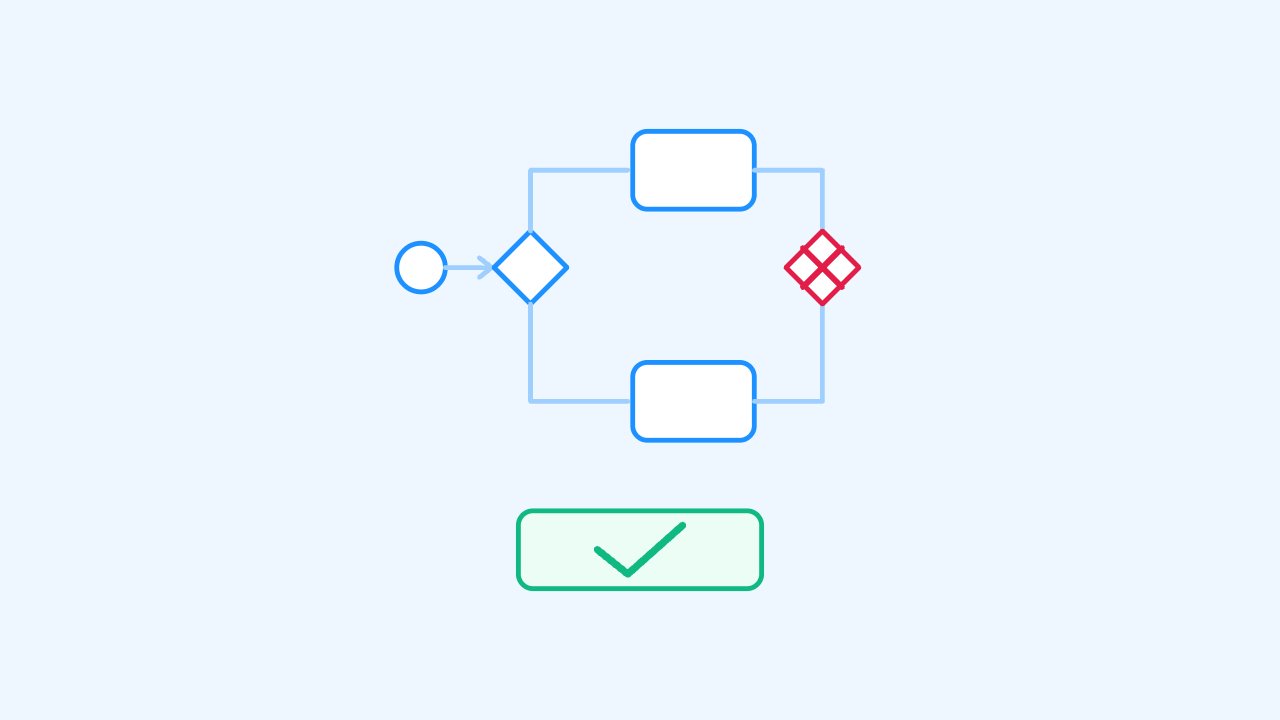
Why mixing departments, systems and roles in the same view quietly breaks a process landscape. We tied each view to a modelling level: on the business level, lanes show responsibilities; on the system level, systems become pools and message flows show their interactions. And we landed on one principle: consistency beats correctness.
The big takeaway
The mistake usually isn't "wrong BPMN". It's mixing different things into the same view.
A department. A system. A role. A participant. BPMN lets you put them together, and the model can even look perfectly reasonable. But now nobody knows exactly what they're looking at.
What we walked through
- 01
Lanes add accountability
A process without lanes still shows the logic and flow. Lanes add the organisational dimension: who is responsible for what, and where do handovers happen?
- 02
More lanes can reveal organisational friction
If a relatively simple process involves ten departments, that's not just a modelling detail. It shows how many handovers, approvals and organisational boundaries sit between the work and the outcome.
- 03
Don't mix organisational and system views
Using departments and systems as lanes in the same model may be technically valid BPMN. But it mixes two different modelling intentions and makes the model harder to interpret consistently.
- 04
Business level: show responsibilities
At the higher, business-oriented level, use lanes for departments, teams and functions to show responsibilities and collaboration. Between lanes, sequence flow is enough. Decompose further when you need more detail.
- 05
System level: show interactions
At a more technical level, model systems as pools to make their interactions explicit, including integration points and APIs. Message flows are for communication between these separate pools.
- 06
Consistency beats correctness
A theoretically perfect BPMN model doesn't help much if every team models the same thing differently. Pick a convention for each level, then stick to it. That's how models become something people can actually use.
Discuss this episode
Ask a question, share how you would model it, or suggest the next topic.
More episodes
All episodes →
We Drove Our Own Expense Process Close to Full Autonomy
Our own finance operation, taken apart and redesigned from scratch around AI. We modelled the ideal on a green field: snap a receipt and the agent labels, classifies and matches it against payments, with weekly runs instead of a month-end scramble. The diagram became the spec for our developers, and the process has been running live ever since.

Value Streams: Turning Scattered Diagrams Into a Connected Landscape
How to organise a pile of loose BPMN diagrams into a landscape that shows how the business actually works. We set out the levels from landscape to value stream segments to business processes to system views, compared top-down and bottom-up approaches, and linked processes horizontally to follow the journey end to end.

Where Should AI Go First? Prioritizing Processes and Tasks With Attributes
How to prioritise AI initiatives from your process models instead of case by case. We ran two passes: on the process level, two simple attributes and a filter produced a shortlist; on the task level, value potential against feasibility picked the first initiatives. In our example that left five concrete opportunities.